Materials & Making
From Fiber to Finished Knitwear: How OEM Production Works
A knitwear design begins as an idea, but its character is decided through a chain of practical choices: fiber, yarn, gauge, construction, finishing, and care. Original Equipment Manufacturer (OEM) production brings those choices together with a manufacturing partner, translating a brand’s brief into a garment that can be made consistently and responsibly.
Published October 28, 2026
The finished sweater may look effortless: a clean shoulder line, a softly rounded sleeve, a ribbed cuff that keeps its shape. Yet the quiet confidence of good knitwear is rarely accidental. Behind it sits a series of connected decisions about raw material, machine capability, pattern engineering, testing, and communication. OEM production is the process through which a brand works with a specialist manufacturer to develop and produce garments or accessories according to a defined set of requirements.
For readers interested in clothing and accessories, understanding the process offers a more useful lens than simply asking whether a garment feels soft. It reveals why two pieces made from similar fibers can wear differently, how a design brief becomes a production-ready specification, and what questions help clarify quality and sourcing. The details matter especially in knitwear, where a small shift in yarn tension or stitch structure can alter drape, warmth, fit, and durability.
What OEM means in knitwear
In an OEM arrangement, a brand defines a product and works with a manufacturing partner to develop and make it. The brand may provide a sketch, reference garment, technical pack, or early concept; the factory contributes expertise in knitting equipment, yarn behavior, garment construction, and production planning. Responsibilities vary by agreement. Some manufacturers source yarn and manage finishing, while others work with materials supplied or approved by the brand.
OEM is not a guarantee of a particular quality level, nor does the term alone identify where a garment was made or how its materials were sourced. Those questions require specific answers. A clear production relationship establishes who is responsible for each stage, which specifications govern the work, how changes are approved, and what standards apply to inspection. The goal is not simply to make a sample look appealing; it is to create a repeatable product that matches its intended design and performance.
1. Begin with a design brief
The opening brief gives the manufacturer a shared point of reference. It describes the garment’s purpose, silhouette, intended wearer, season, approximate price positioning, and essential design features. A brief might call for a relaxed cardigan with a deep V-neck, or a lightweight cashmere beanie with a fold-over cuff. Even at this early stage, precise language helps. “Soft” is a starting impression, not a measurable construction instruction; it needs to be accompanied by decisions about fiber, yarn, finishing, and acceptable variation.
A strong brief distinguishes what is essential from what can change. The proportions of a collar, the placement of a button, or the depth of a rib may be central to the design. A minor shade adjustment may be negotiable if a selected yarn is unavailable. Reference images are helpful for mood and shape, but they should not replace technical information. The more clearly the desired result is described, the easier it is for both parties to identify trade-offs before sampling begins.
2. Choose the fiber—and ask what the name means
Fiber choice shapes a knitwear garment’s hand, warmth, weight, resilience, and care requirements. Cashmere is associated with a fine, soft feel and light insulation; merino wool can offer elasticity and warmth; cotton tends to feel breathable and can produce a more substantial or crisp surface depending on its yarn and knit structure. Blends combine qualities, but the percentage alone does not describe the whole experience. Staple length, fiber fineness, yarn construction, and finishing also influence performance.
“Cashmere,” for example, identifies a fiber category, not a complete quality specification. A useful sourcing discussion asks what the fiber content is, where the fiber is sourced and processed, how the yarn is spun, and what documentation supports the material description. If a blend is proposed, clarify the percentage of each component and whether that composition applies to the finished garment. These details help ensure that labels and product information reflect the actual material rather than a broad impression.
Sourcing conversations should also address traceability and standards. A certification can provide evidence about defined parts of a supply chain, but its scope should be understood rather than treated as a universal endorsement. Ask which facility or material the certification covers, whether it applies to the relevant production period, and what records can be shared. Ethical sourcing is not a decorative phrase: it is a set of questions about origin, processing, labor conditions, and oversight.
3. Develop the yarn and gauge
Fiber is transformed into yarn, and yarn becomes the working material for the knit. Yarn may be spun with different levels of twist, thickness, and ply; each choice affects surface texture, strength, drape, and the way a stitch appears. A lofty yarn can produce a soft, airy fabric, while a firmer yarn may support sharper definition. Color, dye method, and batch consistency also belong in the conversation, particularly when a garment requires multiple panels or a coordinated collection.
Gauge describes the number of stitches and rows over a set measurement, usually assessed with a swatch. It is closely related to machine settings, yarn, and stitch structure. A finer gauge often creates a lighter, more compact fabric; a coarser gauge can give a piece a more open or pronounced knit. Neither is automatically superior. The appropriate gauge depends on the design, desired hand, intended use, and yarn behavior.
The swatch is a small piece of fabric with an outsized role. It gives the team an early opportunity to assess color, texture, weight, stitch definition, and dimensional behavior. A swatch should be evaluated in a state that resembles the finished garment: washed or otherwise finished when relevant, and measured after it has rested. This helps distinguish the character of the yarn from the appearance of an unfinished sample.
4. Turn the concept into construction
Construction translates the silhouette into panels, shaping, seams, trims, and finishing operations. A sweater may be fashioned in separate pieces and linked together, or produced with more fully fashioned shaping, depending on the design and machinery available. Shoulder construction, armhole shape, neckline treatment, hem depth, and seam type influence both appearance and comfort. A cardigan adds further considerations: placket stability, button spacing, buttonhole construction, and the way the front edges hang when worn.
The technical pack gathers these choices into a working document. It may include a flat sketch, measurements, tolerances, stitch details, yarn and color references, grading information for sizes, labels, trims, and finishing instructions. It should also state how measurements are taken. “Chest width,” for instance, needs a defined point of measurement and a clear instruction about whether the garment lies flat. Without that shared method, two people can record different results from the same piece.
Fit is more than a set of numbers. A garment’s intended ease—the difference between body measurements and garment measurements—determines whether it feels close, classic, or relaxed. The same sweater can behave differently across sizes if grading is not considered carefully. Sampling should therefore test the proportions and movement of the garment, not just whether a single prototype matches a sketch.
5. Sample, review, revise
Sampling is where assumptions meet the material. A first sample may reveal that a collar rolls, a sleeve feels too heavy, a hem flares, or the chosen yarn changes after washing. These are not necessarily signs of failure; they are information to guide the next iteration. Each round should be reviewed against the brief and recorded with clear comments, measurements, and photographs or diagrams where useful. Specific feedback—“reduce the cuff depth by one centimetre”—is more actionable than “make it feel neater.”
A fit sample, a pre-production sample, and a production sample may serve different purposes, though terminology varies between manufacturers. The important point is to agree on which sample represents the approved standard before bulk production. If a material, button, color, or construction detail changes after approval, that change should be documented and reassessed. Quiet substitutions can affect the final result even when the garment appears broadly similar at a glance.
6. Define quality in observable terms
Knitwear quality is not one characteristic. It includes consistency of measurements, stitch formation, seam security, yarn integrity, color matching, finishing, and behavior after use and care. A quality plan should identify what will be checked, at which stage, by whom, and against what tolerances. It can also define how defects are classified, how many units are inspected, and what happens when a lot does not meet the agreed standard.
Testing should reflect how the garment is expected to be worn and cared for. Depending on the product, this may include dimensional stability after washing, colorfastness, seam strength, pilling or abrasion evaluation, and checks for loose ends or trim security. No single test predicts every aspect of long-term wear, but a relevant test program can surface foreseeable issues before garments reach customers. Care instructions should be compatible with both the fiber content and the actual finished construction.
Pilling deserves particular nuance. Small surface fibers can form pills through friction, and their appearance depends on fiber length, yarn structure, knit density, and wear conditions. The presence of some pilling does not, by itself, establish that a fiber is counterfeit or a garment defective. Still, expectations should be discussed: what degree of surface change is considered acceptable, how it will be assessed, and what care advice can help reduce friction-related wear?
7. Confirm labels, care, and production details
Labels are part of the product specification, not an afterthought. Fiber-content statements, country-of-origin information, care instructions, size information, and brand identification may be subject to rules in the markets where the garment is sold. Requirements differ by jurisdiction and product type, so brands should verify them with qualified compliance resources rather than relying on assumptions. The manufacturer and brand should agree who supplies, checks, and attaches each label.
Care language deserves particular care. A cashmere garment, a cotton knit, and a wool blend may have different recommendations depending on yarn, dyes, seams, and finishing. “Dry clean only” or “machine washable” should not be selected simply because it sounds convenient; instructions should be supported by testing and consistent with the garment’s construction. Accurate care guidance helps preserve shape and appearance while giving the wearer a realistic understanding of maintenance.
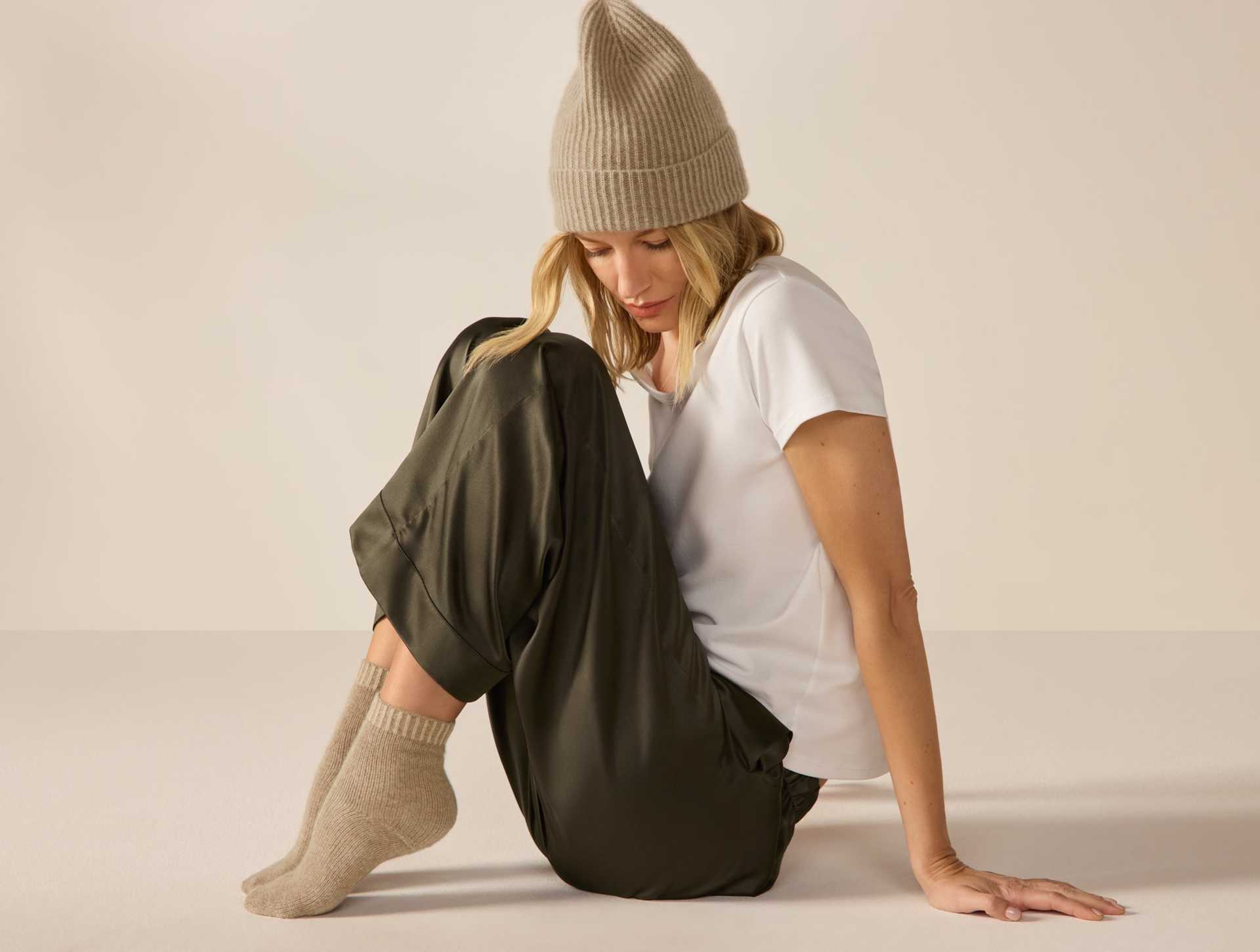
For a public-facing example of how a finished knitwear specification can be communicated, the Whitney Cashmere Beanie is described as 100% cashmere, with a rib-knit construction, two-tone design, fold-over cuff, and dry-clean-only care. Those details do not disclose its full manufacturing process, but they illustrate how material, construction, origin, and care information help readers understand a finished accessory.
8. Plan production and communication
Once a sample is approved, production planning brings together yarn availability, machine capacity, lead times, labor, finishing, packing, and delivery schedules. Knitwear can be especially sensitive to material lead times because a yarn shade or lot may need to be secured before production. Brands should ask what must be approved before the schedule is confirmed and what circumstances could change it. A realistic timetable includes space for review, corrections, and quality checks rather than treating every stage as instantaneous.
Communication is an operational tool. A named contact, agreed update rhythm, written approvals, and a shared version of the technical pack can prevent confusion. Decisions made in calls or informal messages should be summarized in writing, especially when they alter material, measurements, color, or finishing. A concise change log records what changed, when it changed, and which sample or production order it affects.
Production quantities also shape the discussion. Minimum order quantities may reflect yarn purchasing, machine setup, dyeing, or factory workflow. If an initial run is small, ask what trade-offs affect cost and availability, and whether the proposed materials can be repeated for a future order. The lowest initial price does not necessarily produce the most reliable long-term arrangement if the yarn or process cannot be reproduced consistently.
Questions worth asking a manufacturing partner
- Which parts of development and production are handled in-house, and which are subcontracted?
- What is the exact fiber composition, yarn specification, and material origin for the proposed garment?
- How will gauge, measurements, and tolerances be documented and checked?
- Which sample will serve as the approved production standard, and how are later changes authorized?
- What quality checks and relevant performance tests are available for this construction?
- What evidence supports any sourcing, environmental, or labor-standard claims?
- Who is responsible for label accuracy, care instructions, and market-specific compliance?
- How are production delays, material substitutions, and defects communicated and resolved?
A garment is a sequence of decisions
OEM knitwear production is best understood not as a single manufacturing event but as a sequence: a brief becomes a material choice; yarn and gauge shape a fabric; construction gives that fabric form; sampling tests the idea; quality controls turn approval into a repeatable standard. Each stage carries forward the decisions made before it. A vague fiber specification can complicate labeling, while an unclear measurement method can make a fit dispute difficult to resolve.
For a brand, the most useful approach is to treat clarity as part of design. Ask for precise material information, preserve approval records, test the garment in ways that reflect real use, and make sourcing claims that can be substantiated. For the reader, these same questions offer a richer way to understand knitwear: not just as softness or silhouette, but as the result of fiber, craft, engineering, and care working in concert.
The most enduring piece is rarely defined by one dramatic detail. It is the quiet alignment of yarn and gauge, fit and finish, promise and proof. From the first fiber decision to the final label, that alignment is what allows a concept to become knitwear made to be worn, understood, and cared for.